
Beyond Amenity: Designing Student Spaces Around Behaviour
There has been a growing conversation recently about how we live.
Whether it is the rise of creative hobbies, book clubs or the ongoing fascination with 90s nostalgia, there seems to be a wider desire for experiences that feel more authentic and less performative. People are increasingly gravitating towards environments that feel comfortable rather than perfectly curated.
While these trends are often discussed through the lens of lifestyle, they raise an interesting question for the built environment. Are we designing spaces around how people actually want to live, or around how we think those spaces should be presented?
The same question feels increasingly relevant when we talk about PBSA.
I recently attended UKREiiF, where one of the panel discussions focused on co-living. While the sector is different, there are strong overlaps with PBSA, particularly around experience, retention and long-term value. One moment that stayed with me was hearing a student explain why she had chosen to remain in PBSA for a second year. It wasn’t framed around facilities or specification, but around familiarity, comfort, and the sense of community and ownership she had built within her shared space over time.
What became clear across the wider panel discussions was that this wasn’t an isolated example. One of the recurring themes was whether amenity spaces are actually being used in the way they were intended, and which spaces generated the most meaningful day-to-day engagement.
Amenities have many positives – they form part of the offer, help with marketing, and play a role in attracting residents. However, how can we ensure these spaces are genuinely embedded into daily life and align with residents needs?
A well-designed space does not automatically mean it will be used, and a heavily programmed amenity space does not always translate into a lived experience.
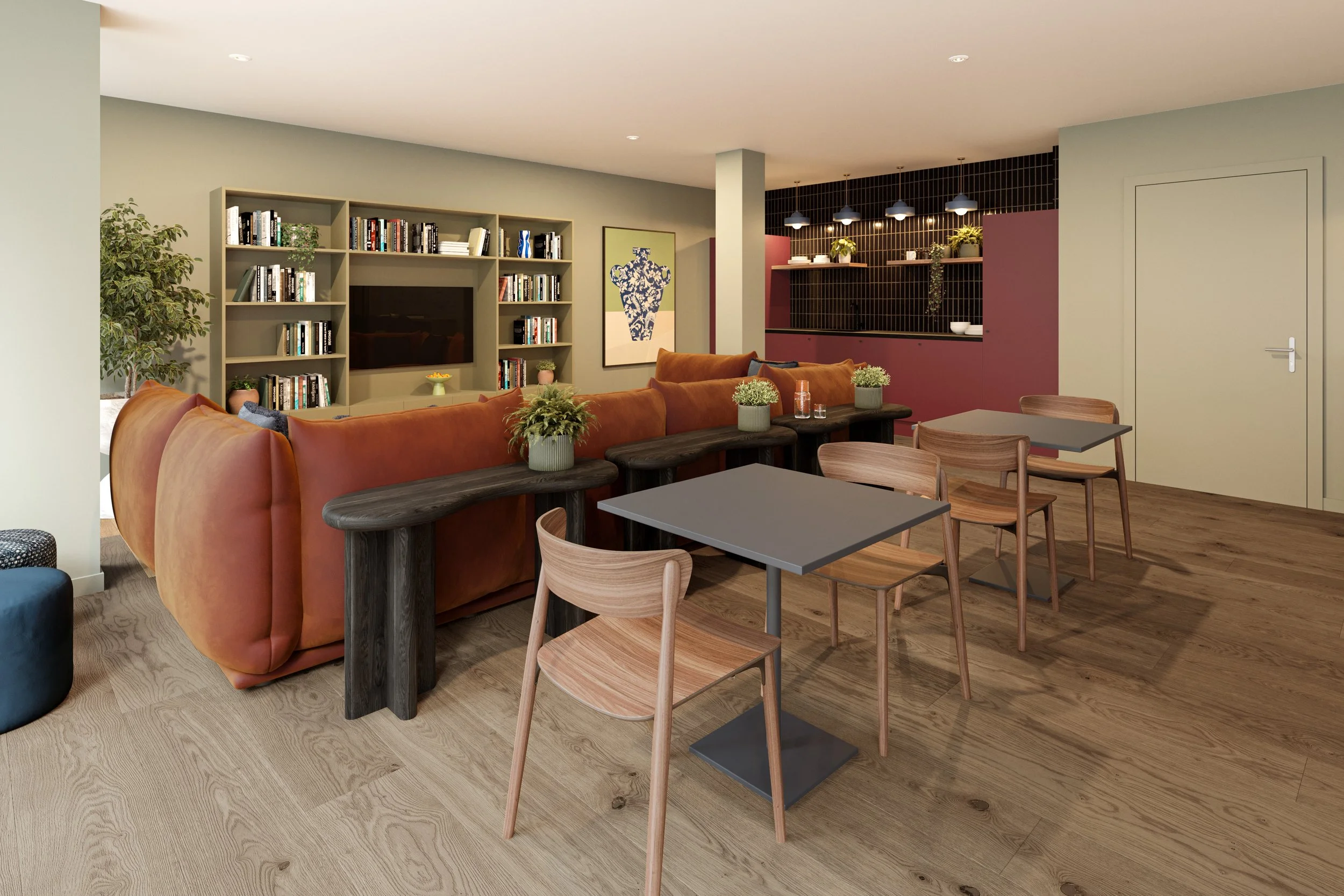
Image versus behaviour
It is easy for amenity to become part of the image of a building. Gyms, cinema rooms, study pods and communal lounges often communicate a lifestyle as much as they provide a function.
But behaviour does not always follow image.
What we are increasingly seeing is that flexibility matters more than definition. Spaces that can shift throughout the day, rather than remain fixed in purpose, tend to work harder in practice. Community kitchens that support both events and everyday cooking. Lounges that accommodate programmed activity but also quiet, informal use. Spaces that don’t require justification to be occupied.
Often, the most successful environments are the ones that sit in the background of daily life rather than competing with it.
The HMO question
This becomes most interesting when you look at how students actually move through different stages of accommodation.
The typical journey has been relatively consistent: first year in PBSA or halls, followed by a move into an HMO with friends. Cost plays a role in that shift, but so does the desire for independence and a stronger sense of ownership over space.
But if you strip both models back, the similarities are quite striking. Shared kitchens. Shared routines. Shared social space. Shared responsibility for how a home functions.
So, the question becomes less about typology, and more about experience.
If the social structure is broadly the same, what actually makes one feel like home and the other feel like a stepping stone?
In our experience as designers, it is rarely about specification or scale. It tends to come down to control, personalisation, and the ability for people to leave traces of themselves within a space.
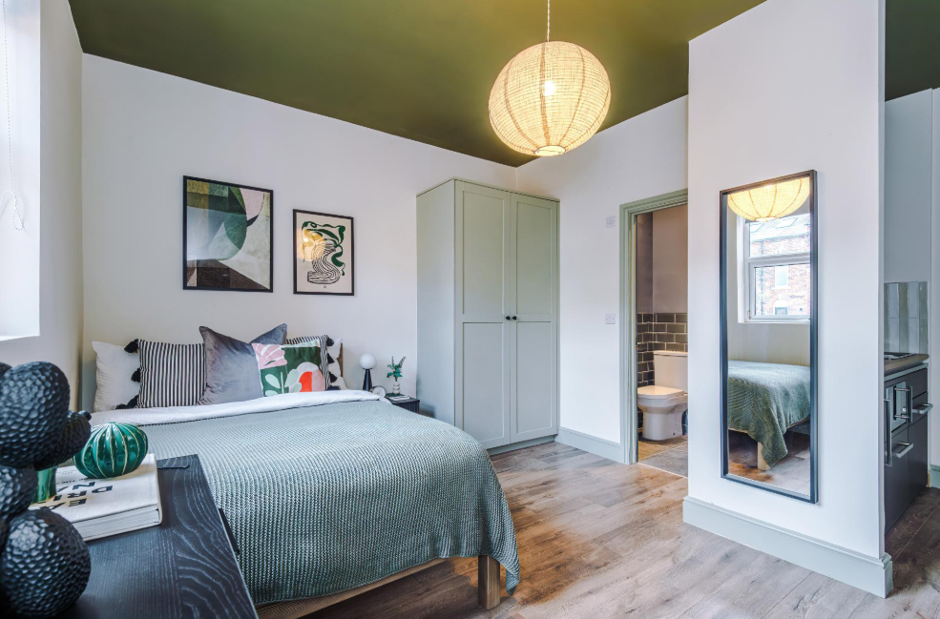
HMOs often feel more “owned” because they evolve over time. Furniture moves. Walls accumulate layers. Objects appear. The space slowly reflects the people living in it.
PBSA, by contrast, is often delivered as a finished product.
That distinction might sound subtle, but it changes everything.
Designing for belonging
This is where the real opportunity sits for PBSA design.
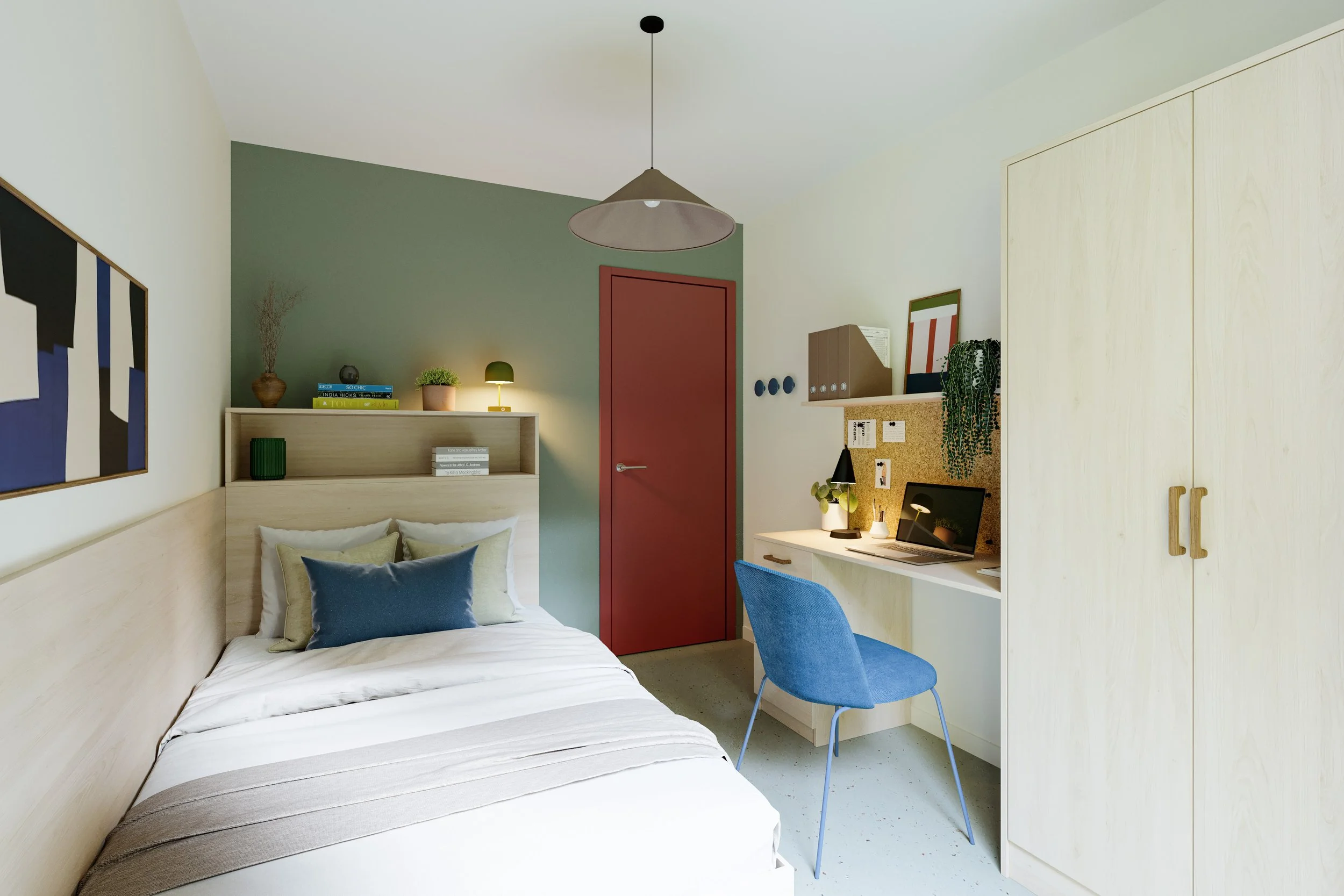
While large communal amenities tend to dominate the conversation, it is often the everyday environments that define how a building actually feels to live in. Bedrooms, cluster kitchens, circulation spaces and shared living areas are where routines form and relationships develop.
From an interior design point of view, this means paying closer attention to the quieter decisions within a scheme. Not just the headline spaces, but the ones students experience every day. The layout of a cluster kitchen, opportunities for personalisation, the way lighting shifts through a space, and the choice of materials that either resist or absorb daily life.
In practice, it is often these quieter decisions that have the biggest impact over time.
As designers, it also means thinking beyond occupation. Not just how a space looks on completion day, but how it behaves six months or a year into use. The most successful schemes are often those that allow that evolution to happen naturally, rather than trying to fix it in place from the start.
These themes were consistent across the UKREiiF discussions, particularly when moving from operator expectations into how students actually describe their lived experience.
What this means for PBSA
For PBSA, the opportunity is not simply to add more amenity, or to refine individual spaces in isolation. It is to think more holistically about how behaviour is shaped across an entire building.
How do students actually move through a scheme across a typical week?
Where do they naturally spend time?
Where do they feel a sense of ownership?
And, perhaps most importantly, what makes them stay longer?
What we consistently take from projects and wider sector discussions is that long-term value is increasingly linked to lived experience rather than specification. Could it be that buildings which respond to how people actually behave are better placed to create lasting value than those defined purely by their initial offer?
Final thought
Ultimately, successful PBSA is not determined by what is provided at the point of completion, but by how a building changes once it is occupied. When design and behaviour align, accommodation stops feeling like a fixed product and starts to feel closer to home.